
AI slop is a failure of judgment.
AI slop is a useful name for generated content published with little original intent, selection, verification or finishing. The problem is not simply that AI was used. A carefully directed synthetic scene and a conventional stock image can sit on opposite sides of the same quality test. What matters is whether someone made accountable choices.
For a brand, the cost is larger than an odd hand or broken reflection. Repetitive imagery weakens recognition. Invented product detail creates risk. An emotionally empty film trains the audience to scroll past the next one. Faster output becomes a liability when selection and review do not scale with it.
1. Start with intent, not volume.
Before generating, state what the audience should notice, understand or do. If the answer is only that the brand needs more posts, there is no creative filter for choosing one image over another. A useful brief includes the message, audience, placement, product truth and the feeling that should remain after the frame is gone.
Google's guidance makes a similar distinction for written content: generative AI may help with research and structure, while producing many pages without added user value can violate spam policy. The studio version of that principle is simple. Do not confuse the ability to make more options with a reason to publish them.
2. Protect truth before polishing style.
A photoreal image is not evidence that its details are correct. Verify product proportions, stones, closures, ingredients, labels, logos, prices and claims against approved sources. For real people, verify consent and the permitted use of their likeness and voice. Put these facts in a locked layer that generation cannot rewrite.
Exact typography and identity marks should usually be composited after the image is selected. This is not a limitation to hide; it is a production decision. Deterministic elements protect the brand while generative tools explore the parts that benefit from variation: environment, light, framing and supporting action.

A closer look at the original image.
Photorealistic does not mean product-correct.
Suppose the left mug is the approved reference. The right image still looks plausible, but the changed handle makes it the wrong product. Lighting quality cannot compensate for that change.
- Check silhouette and proportions before surface polish.
- Mark the handle as the failed feature.
- For a real product, compare with verified photographs, not a generated reference.
AI-generated teaching example. Not client work or a model benchmark.
3. Use five review gates.
First, intent: does the frame express the brief? Second, truth: are product, person and claims accurate? Third, continuity: does it belong to the same campaign as the surrounding work? Fourth, craft: do anatomy, physics, material, light, typography and compression hold up? Fifth, context: are rights, disclosure, crop and platform behavior understood?
A frame that fails one gate should be repaired, replaced or removed. Do not average the scores. Beautiful lighting cannot compensate for an altered product, and a technically clean render cannot compensate for an idea the audience has seen a hundred times. The approval owner should be named before the first generation.
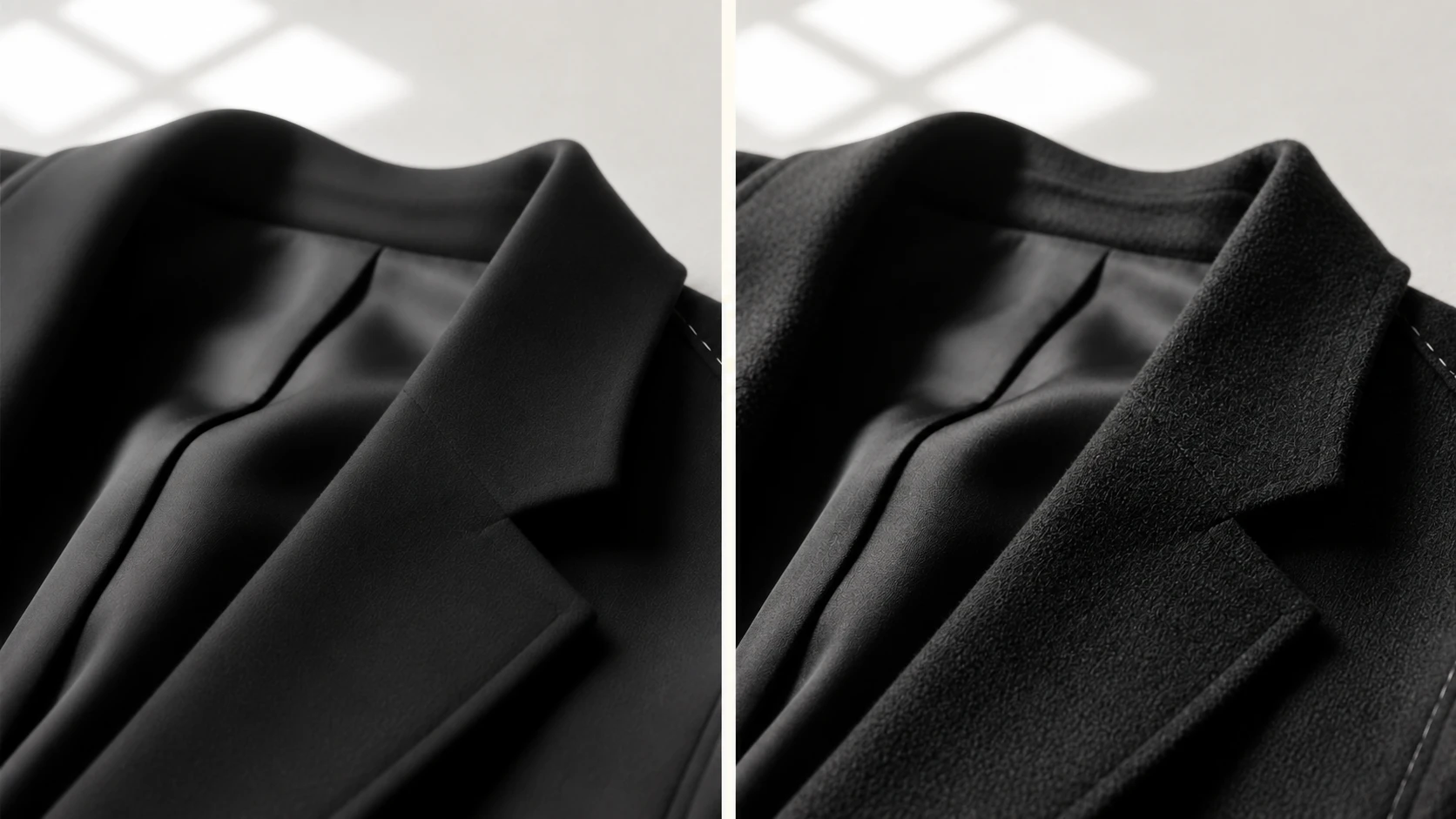
A closer look at the original image.
Inspect material, not just the overall mood.
Compare the lapel edge and the surface around it. The left deliberately suppresses fine texture; the right makes the fibers more legible. More texture is not automatically better: match the real material and the delivery size.
- Does wool still read as wool?
- Are edges clean without looking cut out?
- Check at full size and at the size viewers will actually see.
AI-generated teaching example. Not client work or a model benchmark.
4. Treat provenance as part of delivery.
Content Credentials use cryptographically bound provenance data to record information such as origin, edits and AI use. C2PA is clear about the boundary: a valid credential can help show that recorded provenance has not been tampered with, but it does not prove that the depicted event is true or grant rights by itself.
Keep a human-readable record as well: source references, permission, model or tool, prompt version, selected output, manual edits and approval date. Metadata can be removed during editing or re-upload. The production log remains useful when a platform changes its interface or a client needs to understand how an asset was made.
5. Disclose where the viewer needs context.
As reviewed in September 2026, YouTube requires disclosure for realistic content that was generated or meaningfully altered, while TikTok combines creator labels, detection and Content Credentials for realistic AI media. These systems continue to change, so the upload checklist should be rechecked at delivery rather than copied from an old project.
Disclosure is not an apology and it does not replace consent, copyright review or factual accuracy. It gives the viewer context about how a realistic image or scene was made. Use plain language. If a film mixes live action, generated environments and conventional finishing, say that clearly instead of reducing the process to either fully real or fully AI.
6. Publish fewer assets with more evidence.
The strongest defense against AI slop is not an anti-AI position. It is a stricter edit. Keep the frame that carries the idea, the detail that proves the material and the variation that has a clear channel job. Remove the rest, even when it was inexpensive to generate.
A brand-ready AI asset should leave an inspectable trail: why it exists, what stayed true, what was generated, what was changed by hand and who approved it. That record slows the wrong part of the process and speeds the right one. The tool can multiply possibilities; taste is still the act of refusing most of them.